
Introduction to the Fragment Protocol

The Fragment Protocol aims to build a healthy ecosystem among creators, operators, and players. Through this protocol, creators can license game operation rights as non-fungible tokens (NFTs), known as Fragments. Operators can obtain Fragments within the UniWorlds Marketplace. Fragment owners can then associate their Fragment with a domain name, allowing them to initiate and manage game spaces in the UniWorlds App.
Player spending within the game space—could understand as revenue—will be distributed among game operators, creators, and the platform, thereby promoting a sustainable ecosystem.
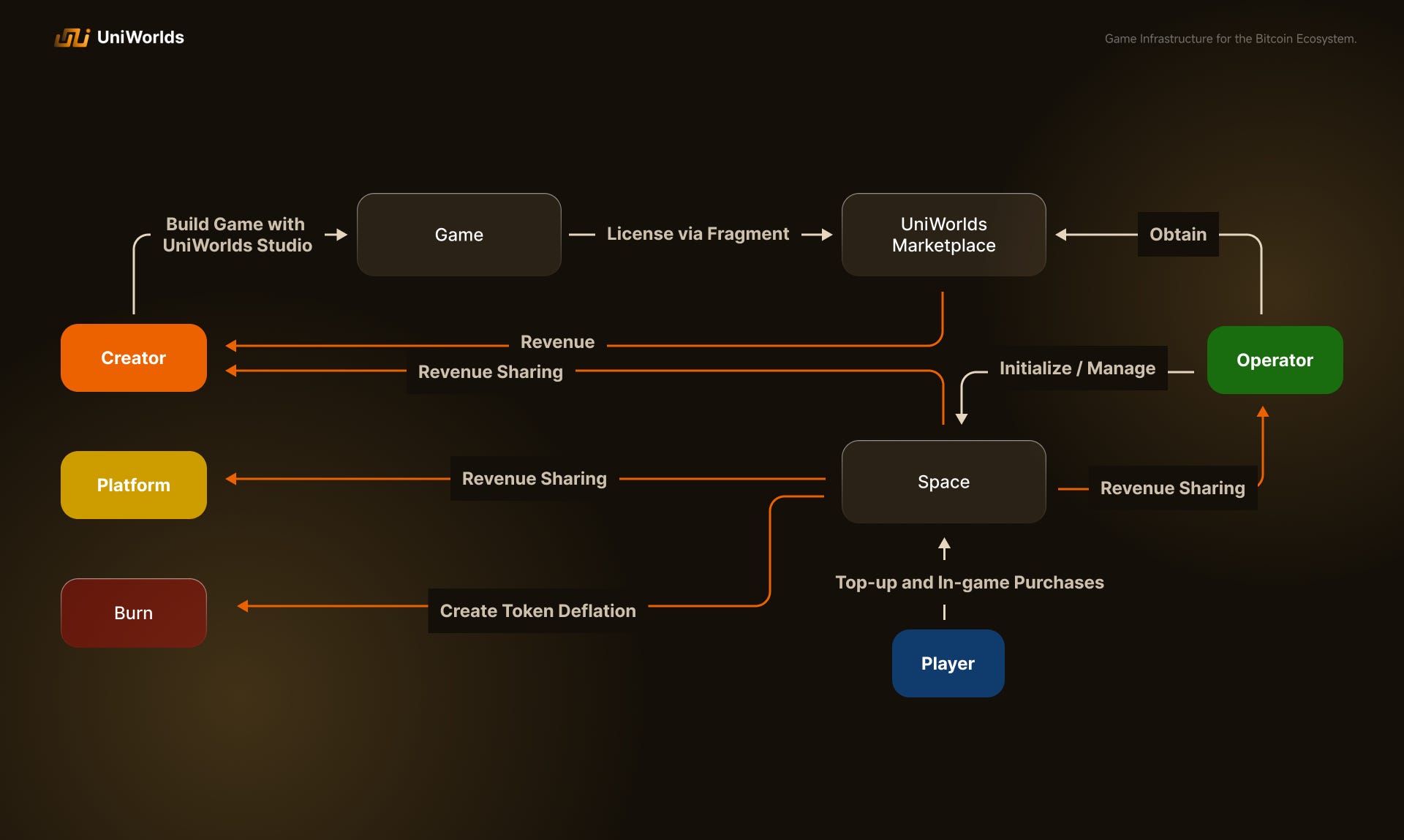
The entire ecosystem consists of four stakeholders: creators, operators, players, and the platform.
For Creators, by using UniWorlds Studio, they can focus more on game development without worrying about blockchain interactions or server configurations. By selling Fragments, they can transfer the operational rights of their games to obtain funding, allowing them to better invest in subsequent development and iteration. Since creators will also receive a portion of the game's ongoing operational revenue, their interests are aligned with the maintenance and quality of the game.
For Operators, they can purchase Fragments on the UniWorlds marketplace to acquire the operational rights for popular games. Within the UniWorlds App, they can bind Fragments to UniWorlds domain names, making them searchable for users. Additionally, they can link servers on the backend to initialize game spaces. Operators can set the in-game currency used for transactions. Of the revenue generated in the space, 10% goes to the platform, 65-75% goes to the operator, and 5-15% goes to the developer (based on actual conditions and creator preferences). The remaining 10% is burned, promoting deflation and creating real value for the Bitcoin ecosystem.
For Players, after downloading the UniWorlds App, they can enter any space to play games. The same game, when managed by different operators, may have different in-game payment currencies, item prices, and specific operational activities. Players can choose different game spaces according to their preferences.
For Platform, it provides infra for game development and operation.
Overview
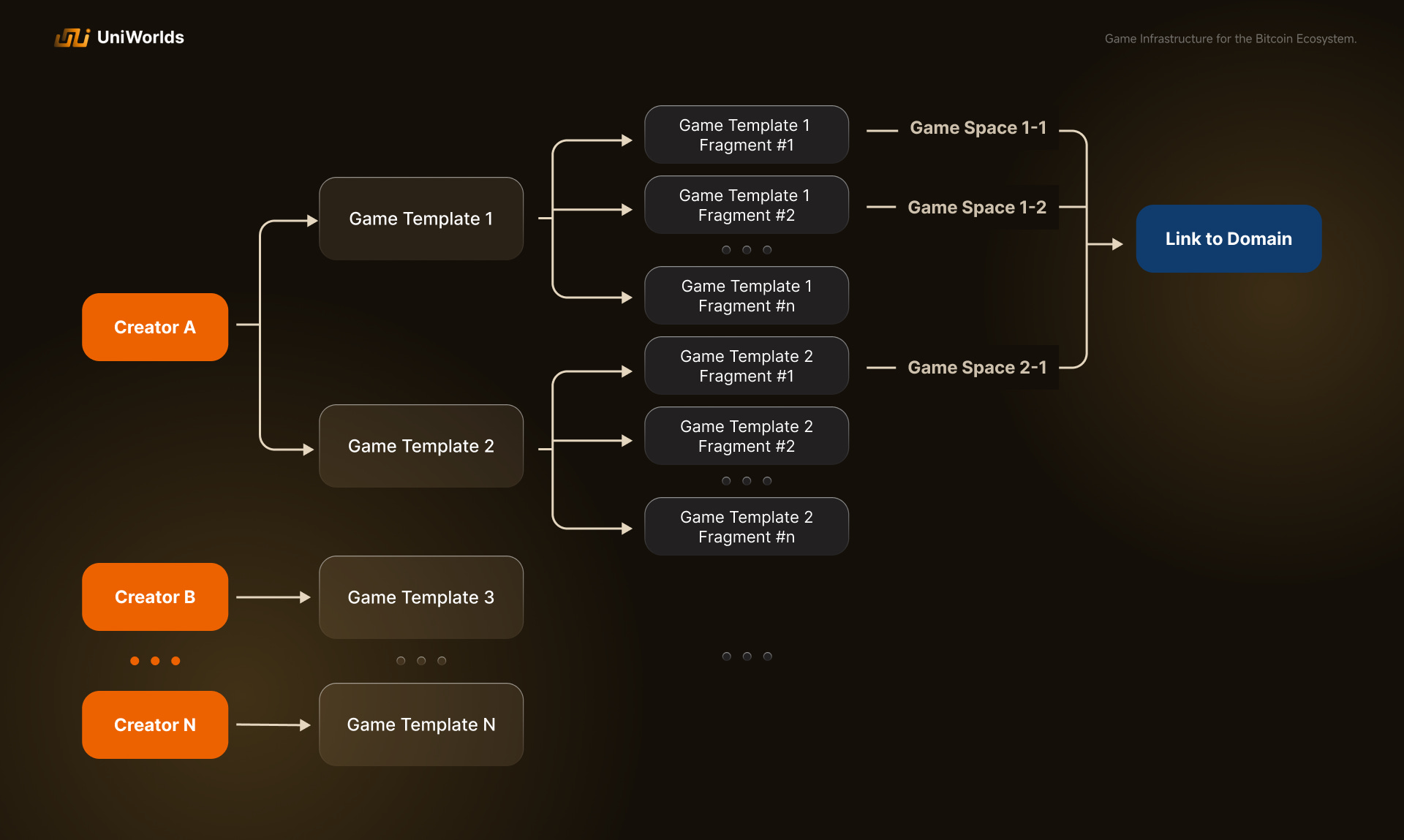
Creators develop games in UniWorlds Studio and set their own prices and editions. They then package the game's operation rights into Fragments and release them on the UniWorlds Marketplace.
Operators who acquire Fragments on the UniWorlds Marketplace become Fragment Owners. They can then bind the Fragment to a domain in the UniWorlds App, and the system will automatically initiate the fragment by configuring the corresponding server resources in the backend. This setup allows players to access the space via the bound domain.
Operators can also configure game parameters defined by the creators in the UniWorlds App. These parameters often include settings such as the in-game currency and the prices of in-game items.
Players can download the UniWorlds App and use either the domain or the leaderboard to find spaces and enter games.
Currently, Fragments support three types of BRC-20 tokens that are bridged to Fractal Bitcoin: ORDI, SATS, and PIZZA, along with the native FB token. Players can make purchases in different spaces according to the circulating currency set by the operator.
Technical Framework
Currently, games are hosted on UniWorlds servers. UniWorlds uses an automated framework to help devs synchronize data on-chain and off-chain, and dynamically allocate game server resources. In the future, this framework will adapt Fractal Bitcoin's smart contracts update and other fractal technical features to gradually form a decentralized operational mechanism. The following diagram shows the current technical architecture.
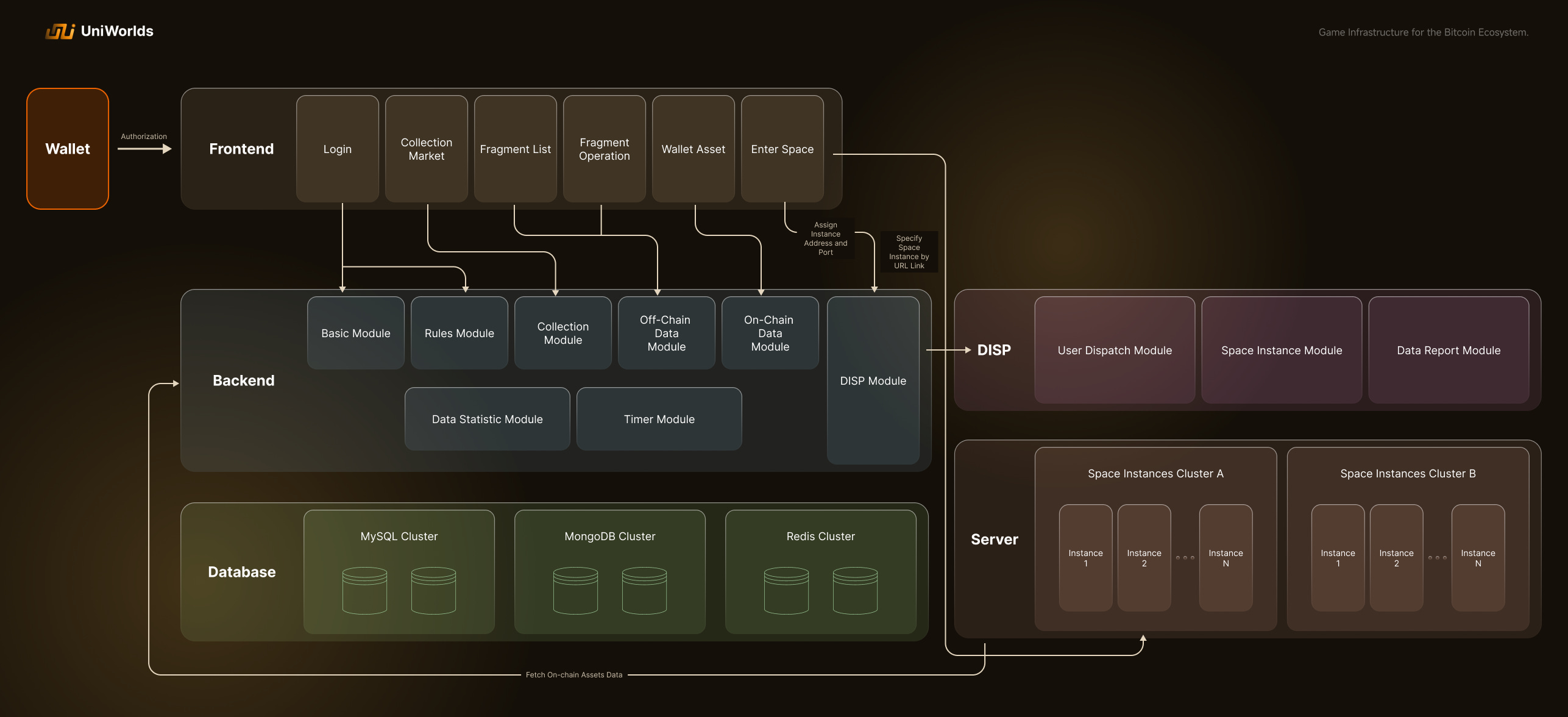
Frontend: This includes modules for the UniWorlds App to interact with Fractal Bitcoin, such as connecting wallets, logging into the platform, supporting whitelist functionality, retrieving asset data, game data, managing assets, etc.
Backend
Basic Module: Handles common features like login, registration, check-in, personal information management, etc.
Rule Module: Supports the whitelist functionality and other access requirements for the UniWorlds App.
Collection Module: Manages all data operations related to Fragment collections.
Off-chain Data Module: Periodically indexes on-chain data to off-chain storage, categorizes, and archives data for specific queries, filters, and rankings.
On-chain Data Module: Reads real-time on-chain data and sends on-chain operation requests. This is facilitated by the UniSat API service.
Timer Module: Synchronizes off-chain and on-chain data at regular intervals.
Data Statistics Module: A dedicated module for recording various statistics.
DISP Module: Coordinates and dispatches server resources among instances.
Database : Supports various types of databases such as MySQL, MongoDB, Redis, etc., according to different needs.
DISP: A framework for dynamically allocating game server resources, automatically determining the provisioning and scaling down of servers based on the number of online users to efficiently support the smooth operation of game spaces.
Server: each game correspond to a instance cluster since they use the similar resource, and each fragment / space correspond to an instance, and all game logic is processed within the instance.